

Foundational Concepts for Mind-Body Wellness
The theory of Yin-Yang and the Five Elements represent one of the most enduring frameworks in traditional Chinese philosophy and medicine. While these concepts may initially seem abstract, they offer practical insights for understanding health, bodily function, and natural patterns. For qigong practitioners, these principles provide essential context for practice and self-regulation.
The Greater Five Elements: A Multisensory Framework
Ancient Chinese philosophers developed a systematic approach to understanding phenomena through five distinct qualities, each corresponding to one of the human senses:
- Form – Physical shape and structure (visual perception)
- Sound – Auditory qualities (hearing)
- Qi/Aura – Scent or energetic presence (smell)
- Color – Visual appearance (sight)
- Taste – Flavor qualities (taste)
This framework, known as the Greater Five Elements, demonstrates an early attempt to categorize sensory experience systematically. The correspondence between these categories and the five senses reflects sophisticated observational thinking about how humans perceive and interact with their environment.
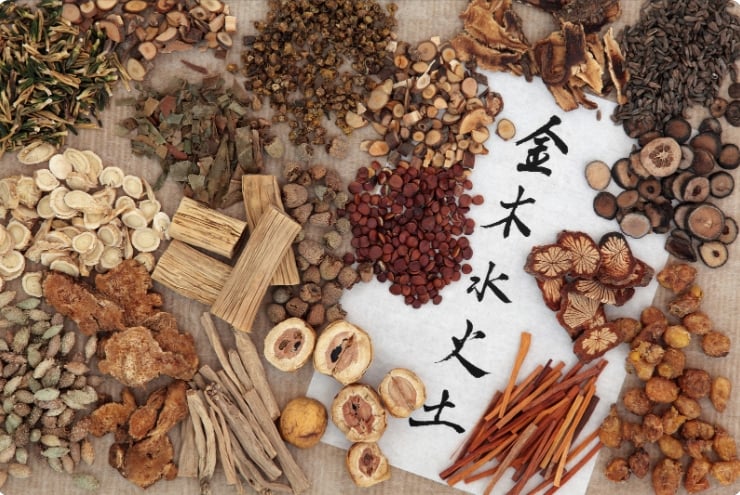
The Lesser Five Elements: Natural Forces and Life Processes
Within the category of Form, traditional Chinese thought identifies five fundamental elements that characterize natural processes and transformations:
Wood – Represents growth, expansion, and upward movement, analogous to plants reaching toward sunlight
Fire – Embodies warmth, transformation, and energetic activity, like the sun’s heat and light
Earth – Symbolizes stability, nourishment, and centering, comparable to fertile ground supporting life
Metal – Signifies structure, refinement, and consolidation, similar to the strength and definition of solid materials
Water – Characterizes flow, adaptability, and downward movement, reflecting water’s ability to conform to its container
These elements function as conceptual categories rather than literal substances. They describe qualities, processes, and patterns observed in nature and applied metaphorically to understand various phenomena, including human physiology and health.
Five-Element Correspondences in the Body
Traditional Chinese medicine maps these five elements onto organ systems, creating a framework for understanding physiological relationships:
Liver (Wood) – Associated with movement regulation, emotional flow, and the smooth distribution of qi throughout the body
Heart (Fire) – Governs blood circulation, consciousness, and mental-emotional activity
Spleen (Earth) – Responsible for digestion, nutrient transformation, and the generation of qi and blood from food
Lungs (Metal) – Control respiration, regulate the flow of qi, and manage the body’s protective functions
Kidneys (Water) – Store essential energy (jing), govern fluid metabolism, and support foundational vitality
These correspondences provide a framework for understanding how different aspects of physiology relate to each other and to broader natural patterns. For instance, persistent irritability might be viewed through the lens of liver (Wood) imbalance in this system.
Interrelationships Between Elements
The Five Elements interact through several dynamic relationships that describe how different aspects of a system influence one another:
Generating Cycle (Mutual Nourishment)
Each element supports and promotes the next in sequence, creating a cycle of enhancement. Water nourishes Wood (as moisture supports plant growth), Wood feeds Fire (as fuel enables combustion), Fire creates Earth (as ash enriches soil), Earth yields Metal (as minerals form in the ground), and Metal enriches Water (as minerals dissolve into water).
Controlling Cycle (Mutual Restraint)
Each element regulates another to prevent excess. Water controls Fire, Fire melts Metal, Metal cuts Wood, Wood breaks up Earth, and Earth dams Water. This cycle represents the principle that healthy systems require both promotion and limitation.
Additional Relationships
Traditional texts also describe patterns of mutual respect (where elements maintain appropriate boundaries) and mutual assistance (where elements support each other’s functions). These concepts elaborate the basic framework to account for more nuanced interactions.
Understanding these relationships helps practitioners recognize patterns of imbalance and identify appropriate interventions for restoring equilibrium.
Practical Applications in Daily Life
Dietary Considerations
Five-Element theory suggests seasonal and constitutional approaches to food selection. Spring’s association with Wood and the liver suggests incorporating sour flavors during this season. Summer’s connection to Fire and the heart may indicate benefit from bitter flavors like those in certain vegetables.
Emotional Regulation
Different emotions correspond to specific elements and organs in this system. Anger relates to Wood and the liver, suggesting that techniques promoting liver qi flow (such as gentle stretching or deep breathing) may help regulate intense emotional states.
Exercise Selection
Constitutional types based on dominant elements may benefit from different physical activities. Those with Wood characteristics might favor flowing, stretching exercises, while Fire types may thrive with more vigorous aerobic movement.
Seasonal Living
Traditional recommendations suggest aligning sleep patterns and activities with seasonal energy shifts. Spring encourages earlier rising to match Wood’s upward energy, while winter suggests later waking to preserve kidney (Water) essence.

Five-Element Applications in Qigong
Six Healing Sounds
This practice employs specific vocalizations associated with different organs:
• He (呵) – Heart
• Hu (呼) – Spleen
• Chui (吹) – Kidneys
• Xu (噓) – Liver
• Xi (嘻) – Triple Burner
• Si (呬) – Lungs
These sounds are practiced to regulate organ function and promote energetic balance.
Five-Element Movement Practices
Specific movement sequences (Daoyin exercises) correspond to different elements and can be selected based on seasonal influences or individual constitutional needs.
Internal Awareness Cultivation
Meditative practices develop sensitivity to qi flow and organ function, allowing practitioners to identify imbalances and adjust their practice accordingly.
Note: Qigong practice benefits from qualified instruction to ensure safe and effective technique. Self-practice should develop gradually, with attention to individual response and comfort.
Integrating Traditional Frameworks with Modern Practice
The Five Elements system offers a holistic perspective on health that emphasizes relationships, patterns, and dynamic balance rather than isolated symptoms or mechanical cause-and-effect. While this differs from biomedical approaches, many practitioners find value in both perspectives.
Understanding these traditional concepts can deepen qigong practice by providing context for why certain exercises are practiced at particular times or for specific conditions. The framework encourages attention to subtle patterns in how the body responds to practice, seasonal changes, and lifestyle factors.
Conclusion
Yin-Yang and Five-Element theory represents sophisticated traditional thinking about health, nature, and the human experience. For qigong practitioners, these concepts provide valuable frameworks for understanding practice principles and guiding self-regulation.
While the language and concepts may seem unfamiliar initially, their practical applications become clearer through consistent practice and observation. The theory encourages attention to patterns, relationships, and subtle shifts—skills that enhance both qigong practice and general health awareness.
For those interested in exploring these concepts through practice, beginning with foundational qigong methods under qualified instruction provides experiential context for understanding these traditional principles.
This article provides educational information about traditional Chinese medical theory as applied to qigong practice. These concepts represent historical frameworks for understanding health and should be understood as complementary perspectives rather than substitutes for modern medical care.
