

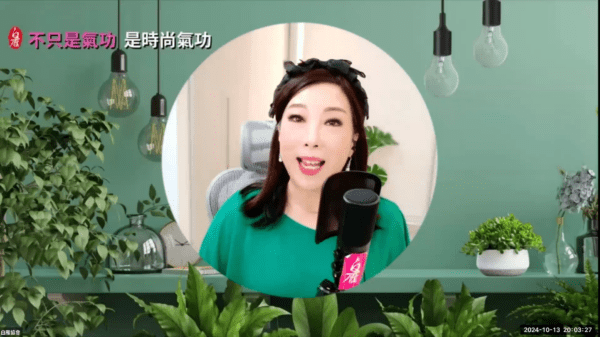
Master Bai Yin offers practical guidance on how to practise Bai Yin YoungQi more effectively, from understanding why the practice makes us sweat to refining two of its signature movements, the Dragon Orb of Qi Technique and the Dragon Soaring Technique. Here are the key points.
Why YoungQi Makes Us Sweat
Practitioners often notice they sweat far more during YoungQi than during EnerQi. Master Bai Yin recalls practising EnerQi during a winter in Hokkaido and finding that his palms stayed extremely cold and would not warm up. When he switched to YoungQi, especially the Turtle Longevity Technique, he felt his whole body warm and noticed he sweated considerably more.
The difference lies in the movement of the spine and torso. Moving the vertebrae does more than move the limbs; it also stimulates the body’s internal structures. This helps increase blood circulation, while the compression of the internal organs generates additional heat, which is why sweating tends to follow.
Sweating: Western and Traditional Chinese Medicine Perspectives
The Western medicine perspective. Sweating is primarily a process of thermoregulation. When the body becomes too hot, sweating helps dissipate heat, supporting a healthy body temperature. Sweat may also carry away small amounts of certain waste products, although its primary role is temperature regulation rather than detoxification.
The Traditional Chinese Medicine (TCM) perspective. In TCM, sweating is associated with “dispersing and promoting the movement of qi” and is viewed as a sign that qi and blood are circulating more freely. It is also regarded as a way to help expel internal “dampness” and “pathogenic influences.”
This is considered particularly relevant in humid environments such as Taiwan and Southeast Asia. In TCM theory, sweating can help release excess moisture, regulate the functions of the Spleen and Stomach, and support digestion. For those who lose their appetite in humid summers, a little sweating may help stimulate it.
TCM also emphasises sweating as a means of dispelling cold and resolving dampness. In cold, damp winters, when cold and dampness are believed to accumulate more readily in the body, generating heat through qigong or exercise is traditionally regarded as a way to help release them.
Sweating Does Not Always Mean Detoxification
Many people assume that sweating automatically means detoxification, but this deserves closer examination. Not all sweating has a detoxifying effect. Sweat produced in hot environments such as saunas or hot springs is approximately 99% water, which reflects fluid regulation rather than true detoxification.
In TCM theory, if the aim is to eliminate substances such as heavy metals or pesticide residues, smooth qi flow through the meridians is considered a prerequisite. If the meridians are obstructed, even profuse sweating may release little more than water. For this reason, maintaining smooth qi and blood circulation during practice matters if sweating is to genuinely support the body’s condition.
Sweating and Constitution in TCM
According to TCM, both excessive and insufficient sweating may indicate an imbalance in the body’s constitution. Excessive sweating may be associated with Yang deficiency, Yin deficiency, or damp-heat.
Spontaneous sweating (Yang deficiency). Sweating after only slight movement, particularly around the head, may point to a Yang-deficient constitution in TCM theory. The Turtle Longevity Technique and VitalQi are traditionally recommended for this pattern.
Night sweating (Yin deficiency). Sweating during sleep, sometimes dampening the pillow, with little sweating by day and possibly a dry mouth and throat, may indicate a Yin-deficient constitution. The intermediate-level YoungQi movements are recommended to help balance Yin and Yang.
Damp-heat constitution. A sticky feeling in the body, fatigue, weakness, and poor appetite may indicate excessive dampness according to TCM theory. The beginner and advanced EnerQi routines are recommended to help dispel dampness.
Refining the Dragon Orb of Qi Technique
The Dragon Orb of Qi Technique repeatedly and thoroughly mobilises the waist, hips, joints, and lower body. Because modern lifestyles involve so much sitting, many people carry considerable tension in the lower body, and this technique can help release it and improve blood circulation.
It is also one of the more challenging techniques to master. Master Bai Yin identifies one common problem: excessive tension in the lower body. When the lower body is too guarded, the opening and closing movements at the heart of the technique become difficult. When the lower body can open and close smoothly, energy can flow freely through the whole body, which is why the technique is considered particularly effective for relaxing and strengthening the lower body.
Difficulties along the way are a normal part of learning, and the issues others encounter may be the very ones worth watching for in our own practice. Approaching the practice with gratitude and mutual support helps create a positive cycle of learning.
Refining the Dragon Soaring Technique
The key to the Dragon Soaring Technique lies in the twisting and stretching of the spine. It is intended to stimulate the meridians surrounding the spinal column, support the functions of the internal organs, and improve balance and flexibility. The movements may appear simple, but performing them correctly requires a high degree of control over the waist.
Summary
Understanding why we sweat in YoungQi, and what that sweating can and cannot tell us, deepens appreciation of the practice. Attention to the finer details of the movements, particularly relaxing the lower body in the Dragon Orb of Qi Technique and controlling the waist in the Dragon Soaring Technique, helps practitioners make fuller use of them. With consistent practice and perseverance, the benefits to constitution and overall well-being can build steadily over time.
This article presents traditional Chinese medicine perspectives and qigong practice guidance for general educational purposes. It is not a substitute for professional medical advice, diagnosis, or treatment. Anyone with health concerns, including unusual or excessive sweating, should consult a qualified healthcare provider.
